
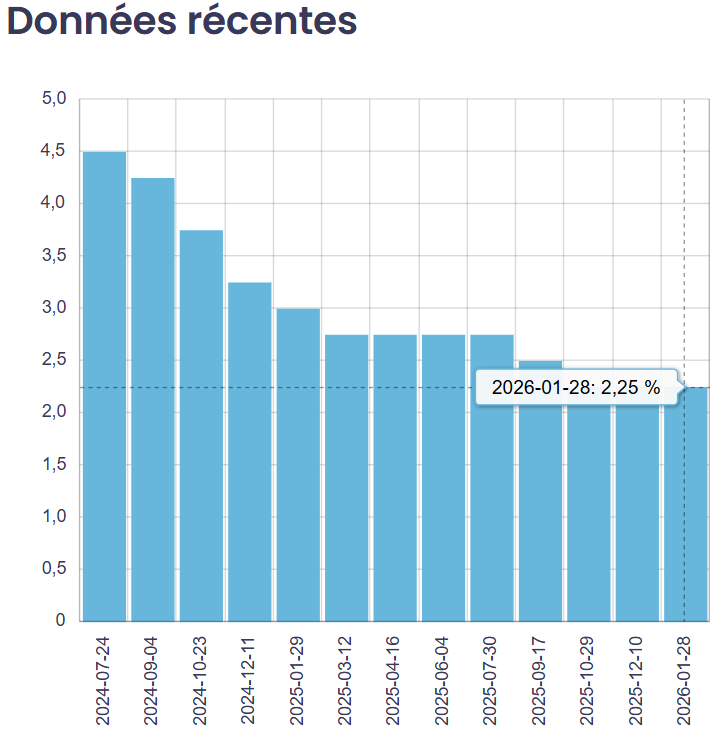
The Governing Council believes that the current level of the rate remains appropriate to keep inflation close to the 2% target, while helping the Canadian economy navigate a period marked by trade uncertainty and geopolitical tensions.
The Bank projects modest economic growth in the near term, with GDP expected to rise by 1.1% in 2026 and 1.5% in 2027. The evolution of North American trade relations, particularly the upcoming review of the Canada–United States–Mexico Agreement, represents an important source of uncertainty.
On the inflation side, the Consumer Price Index reached 2.4% in December, mainly due to temporary factors. However, the Bank expects inflation to remain near the 2% target over the coming months.
In this context, the Bank of Canada reiterates that it stands ready to adjust its monetary policy should the economic outlook change significantly. It remains committed to preserving price stability and maintaining Canadians’ confidence during this transition period.
The next policy rate announcement is scheduled for March 18, 2026. We will continue to closely monitor economic developments and their impact on the mortgage market.
Implications
The Bank of Canada’s target for the overnight rate determines the prime rate set by major financial institutions, which is the benchmark used to price variable-rate mortgage loans. Therefore, today’s announcement is not expected to change the rates currently offered on variable-rate mortgages.
However, the Bank of Canada’s policy rate does not directly determine fixed mortgage rates.
Why use a mortgage broker?
In a context where Bank of Canada decisions are increasingly difficult to anticipate, it is all the more important to rely on an expert. A mortgage broker can help you understand the impact of changes in the policy rate on your financing strategy and guide you toward an option that suits your situation, whether you are purchasing a home, renewing your mortgage, or refinancing.